
A friend recently asked me a question that seems easy to answer but has many nuances. He had the money saved up and was wondering whether he should simply pay cash for the flat or take a loan. There was not a straightforward answer, one that only depended on his savings, income capacity and age, as well as risk profile.
Asking this question in the context of Delhi is even more pertinent since buying a modest flat would usually surpass the one crore mark. Let’s take a look at the pros and cons of both the options.
(Note: The calculations and tax benefits mentioned below are approximate. Interest rates and applicable tax laws may vary, and it is recommended to consult with a financial advisor before making any decisions.)
Pros of Paying Cash
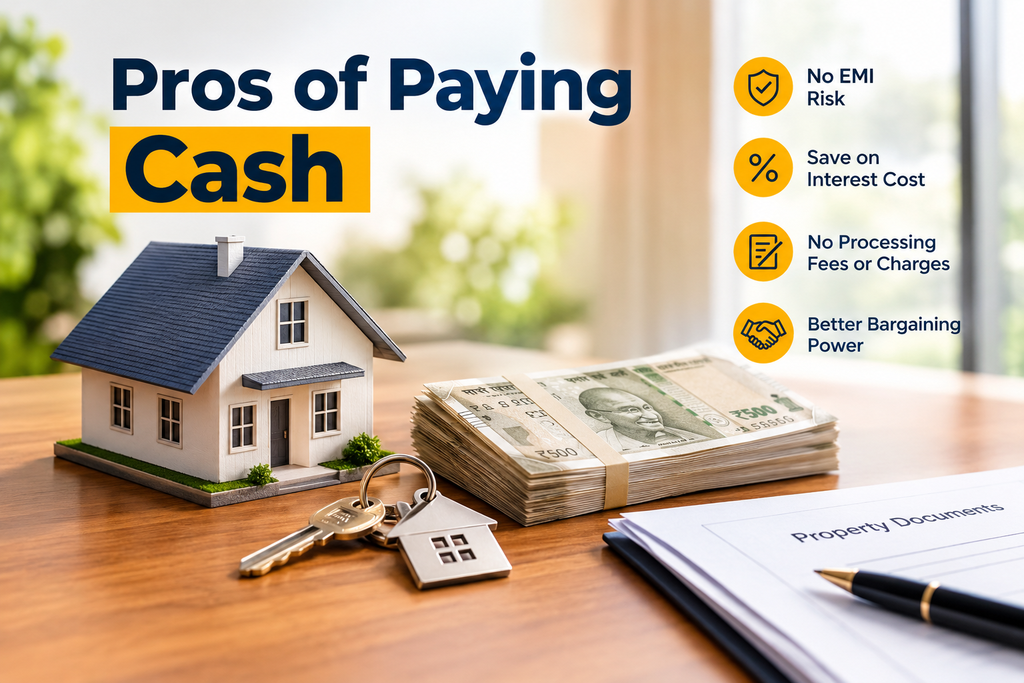
By paying cash for your home, you eliminate the risk of defaulting on your EMI payments. This also eliminates the need to worry about what you will pay if your income source is disrupted. Furthermore, there is also the benefit of the bank not having a lien on your property.
The amount saved on the interest on the loan is considerable. Taking an example of a 1 crore loan at approximately 8.5% over twenty years, the interest that would be paid on the loan would be nearly 1 crore. By paying cash, you can eliminate this recurring expense altogether.
There is no need to tie up time and effort with processing fees, loan sanction, and valuation by the bank. In addition, in case of resale flats, cash can help you bargain for a better rate as the seller would prefer a quick handover.
A cash buyer often holds an advantage over a loan buyer and can expect to pay less for the same property.
Pros of Taking a Loan

If you were to pay cash for a 1.5 crore flat, you are tying up a significant portion of your liquid assets in your primary residence. This makes it extremely difficult to raise funds in case of any emergency such as medical bills or an unexpected business opportunity. On the contrary, taking a loan allows you to utilize the saved money in the form of a down payment and keep the rest as your emergency fund or investment.
If the rate of return on your investments is higher than the interest rate on the loan, it is mathematically feasible to make up for the amount being paid as EMI by utilizing the money saved on the down payment.
Under the old tax regime and for self-occupied homes, taxpayers can claim tax deductions on the interest paid on the home loan as well as the principal repayment. Additionally, if a couple buys a home and repays the loan jointly, each spouse can claim their share of deductions. However, under the new tax regime, these deductions are typically not available, and it is crucial to consult a chartered accountant before taking advantage of these benefits.
For some, the prospect of a monthly EMI serves as a motivator to save more money. Furthermore, a good loan repayment record boosts your credit score.
Cons of Paying Cash
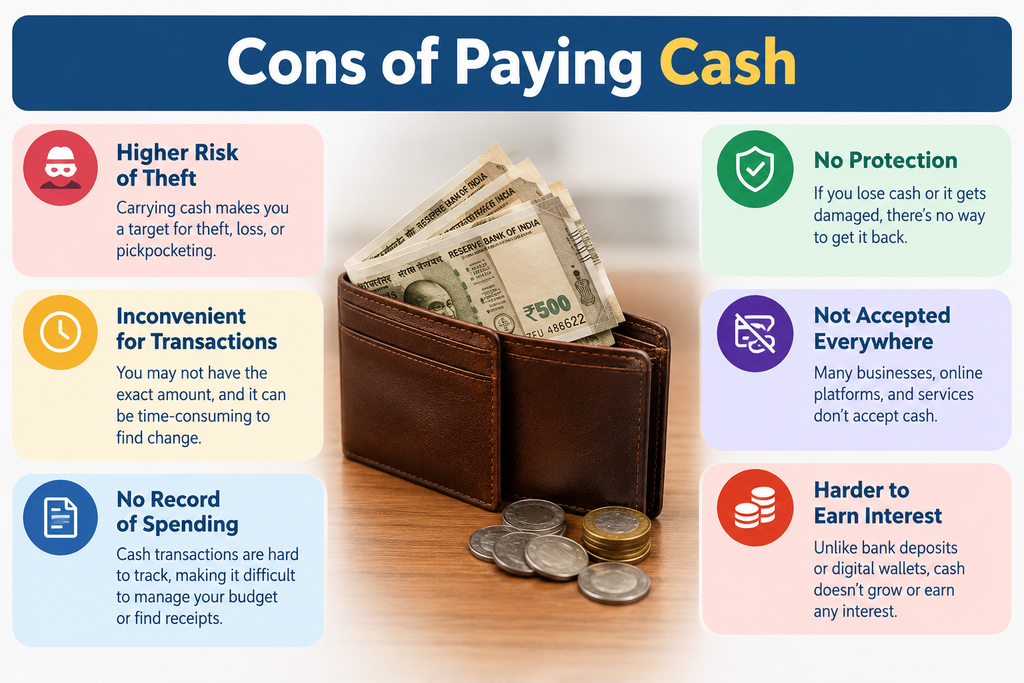
If your net worth consists of mostly equity in a house, you are exposed to taking a big hit if the property value takes a dive. Paying cash does not protect you from such risks. For instance, if you have invested 80% of your life savings into your home in Dwarka, and the value of the property depreciates, you cannot simply sell your home to pay off debts or to fund your retirement.
Cons of Taking a Loan
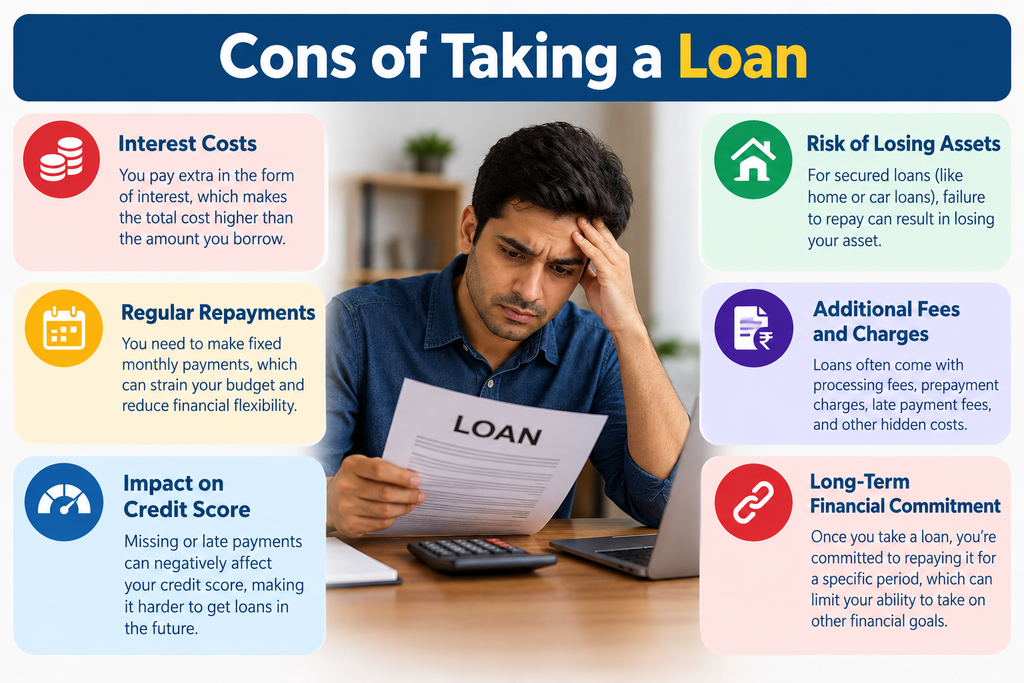
Exposure to rate hikes and income risks. As most home loans in Delhi have a floating interest rate, the EMI or the tenure of the loan can be impacted by changes in the repo rate. Furthermore, if the borrower loses their job, the bank will not pause the EMI; hence, the borrower will continue to have to pay the same amount as before. The second risk associated with taking a home loan is the impact it can have on future lending. The bank or the financial institution considers the total liabilities undertaken by the borrower and their ability to clear the EMIs. Therefore, taking a loan can affect your capacity to take a loan in the future.
An Illustration
Assuming that you have 1.2 crore in your savings account and you find a 1.2 crore flat
You will have to spend roughly 1.2 crore on the flat. The money can be used to pay off stamp duty and other charges, leaving only a small amount of money in your savings account. However, you will not have to pay any interest on a loan.
You will be required to pay a down payment of roughly 25%. The down payment is therefore 30 lakh, leaving 90 lakh that you can borrow from the bank. Assuming an 8.5% rate of interest and a tenure of twenty years, your monthly EMI will be around 78,000.
After factoring in your down payment and the 90 lakh, the question remains as to whether the money saved on the interest will exceed the opportunity cost of not investing the 90 lakh. If you have a sound tax regime, the rate of return on the 90 lakh for a regular fixed deposit, is unlikely to be better than the 8.5% interest on the home loan. With equity, however, there is potential for earning higher returns.
A middle path
You don’t always have to choose between paying cash and taking a loan. Many rational buyers often take a loan with a sizeable down payment and utilize the extra money they have saved on the down payment to make further prepayments on the loan. Most floating rate home loans for individual buyers allow partial prepayment without any penalty. It is therefore possible to reduce the interest you have to pay significantly.
Another option is to have sufficient funds in your emergency fund (between six to twelve months of expenses) and invest your extra income towards the down payment. This way you will never be house-rich and cash-poor.
Which is better: Paying Cash or Taking a Loan?
I think in this post I have highlighted why paying cash tends to suit individuals who are nearing or are in retirement, are risk-averse and dislike owing money and have sufficient liquid funds after paying for the flat. On the other hand, taking a loan suits better those who are in their earning years and want money to stay liquid as well as those who can benefit from the tax deductions for a self-occupied home and have a stable income to pay the EMI for a reasonable tenure (between 10-20 years). Furthermore, it is unlikely that your EMI should take more than 35-40% of your monthly income.
Final thoughts
There is no simple answer when it comes to the choice between a home loan and paying cash. Either option can work out well for you if they suit you financially. However, whichever option you choose, it should not jeopardize your financial stability. After all, a home in Delhi is great, but so your emergency fund and liquid cash.
This is a general financial guidance piece. As always, please seek out the help of a financial advisor.
A brief note: Since every AI detector is different, no text is undetectable. To make it more personalized, feel free to add some personal anecdote or an example to illustrate a point or two. Furthermore, it is always a good idea to rephrase sentences that have been written in a similar way. I can also provide you with the text in a Word file.